
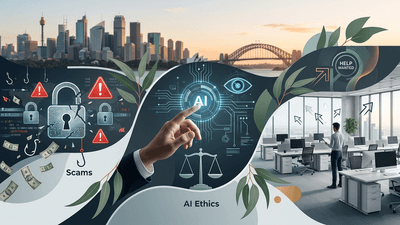



For Australian accountants, the traditional role of "number cruncher" has been obsolete for a decade. But as we navigate deeper into a complex regulatory and economic environment, professionals find themselves playing a far more demanding—and exhausting—role: the ultimate guardians of client trust. Today, that trust is under siege from three distinct but interconnected fronts: increasingly sophisticated cyber scams, a crippling nationwide talent shortage, and the ethical minefield of rapid artificial intelligence adoption.
To understand the sheer pressure cooker that is modern Australian practice management, we only need to look at the headlines from the past month. Industry bodies are sounding alarms across different sectors, but when viewed together, they paint a picture of a profession at a critical inflection point. How firms respond to this "Trust Trilemma" will determine not just their profitability, but their sheer viability in the years to come.
The Frontline of Fraud: Why the ATO Must Empower Tax Agents
The first pillar of the trilemma is security. As cybercriminals deploy increasingly sophisticated spoofing technologies, the line between a legitimate government directive and a malicious scam has never been blurrier. Recently, the Australian Taxation Office (ATO) introduced a call verification feature allowing taxpayers to confirm whether the person on the other end of the line is genuinely an ATO representative.
However, this feature currently leaves a glaring vulnerability in the ecosystem: the tax agents themselves. The Institute of Public Accountants (IPA) has urgently called on the ATO to expand this call verification feature directly to tax agents, arguing that it is a critical protection mechanism for both practitioners and the taxpayers they represent.
"Tax agents are the intermediaries, the first responders when a client panics over an aggressive phone call demanding immediate payment. If the agents themselves cannot efficiently verify ATO communications, the entire defensive line crumbles."
For accounting professionals, the practical implication is clear: you are the primary shield against financial fraud for your SME clients. The IPA's advocacy highlights a growing frustration within the profession—practitioners are expected to maintain immaculate compliance and security standards, yet are often left waiting for the administrative tools required to execute those duties efficiently. Until the ATO expands this feature, firms must implement their own rigorous internal protocols for verifying government communications, treating every unsolicited contact with baseline suspicion.
The Talent Drought: Defending the Gates with Half an Army
Vigilance against scams requires time, attention to detail, and experienced personnel. Unfortunately, human capital is exactly what Australian firms are lacking. The second pillar of our trilemma is the severe workforce crisis.
A recent survey by Chartered Accountants Australia and New Zealand (CA ANZ) has laid bare the reality: there is a nationwide shortage of general accountants, tax accountants, and external auditors. This isn't merely a recruitment headache; it is a systemic operational risk.
When firms are chronically understaffed, several dangerous secondary effects emerge:
- Burnout and Human Error: Overworked staff are more likely to miss the subtle red flags of a phishing email or a fraudulent client request.
- Reduced Advisory Capacity: Time spent putting out compliance fires leaves no room for the high-value advisory work clients desperately need in a tight economy.
- Audit Quality Risks: The specific shortage of external auditors threatens the integrity of financial reporting across the broader corporate landscape.
Firm leaders can no longer rely on traditional recruitment pipelines to solve this issue. The shortage of graduates entering the profession means that retaining existing talent—through better work-life balance, competitive remuneration, and engaging work—is now a critical risk management strategy.
The AI Dilemma: Efficiency vs. Ethics
Faced with mounting compliance pressures and a shrinking workforce, firms are naturally turning to technology to plug the gap. Artificial Intelligence (AI) promises to automate the mundane, draft communications, and analyze vast datasets in seconds. But this brings us to the third and most complex pillar of the trilemma: ethical AI adoption.
CPA Australia has issued a timely warning that ethics are becoming vastly more important in the age of AI. As the adoption of generative AI tools skyrockets, the accounting profession faces unique ethical hurdles that other industries do not.
Consider the practical risks for a mid-tier firm rushing to implement AI:
- Client Confidentiality: Feeding sensitive financial data into public Large Language Models (LLMs) can constitute a severe breach of privacy and client trust.
- The "Hallucination" Factor: AI models can confidently generate incorrect tax advice. If an overworked junior accountant relies on this output without verification, the liability falls squarely on the firm's partners.
- Bias in Auditing: Using AI to sample data or flag anomalies can introduce algorithmic bias, potentially missing critical irregularities.
CPA Australia's stance is a reminder that while AI is a powerful tool, it requires human oversight governed by the profession's foundational ethical codes: integrity, objectivity, and professional competence.
Navigating the Trilemma: A Strategic Framework for Firms
How do Australian accounting firms survive—and thrive—when caught between the demands of heightened security, severe staff shortages, and the ethical implementation of AI? The answer lies in breaking down the silos between IT, HR, and Practice Management.
Below is a strategic matrix for firm leaders to navigate these intersecting challenges:
| The Threat Vector | The Core Impact | Strategic Mitigation for 2026 |
|---|---|---|
| Sophisticated Scams (ATO Impersonation) | Erosion of client trust; potential financial loss; increased time spent on verification. | Support IPA advocacy for agent verification tools. Implement strict internal "zero-trust" verification protocols for all incoming government and client financial requests. |
| Nationwide Talent Shortage | Burnout; increased error rates; inability to scale advisory services. | Pivot from aggressive recruitment to aggressive retention. Redesign workflows to eliminate low-value tasks, keeping your best people engaged in meaningful work. |
| Unregulated AI Adoption | Data privacy breaches; ethical violations; liability for incorrect AI-generated advice. | Develop a formal "AI Acceptable Use Policy" for the firm. Invest in secure, closed-environment AI tools designed specifically for accounting, rather than public LLMs. |
The Interconnected Solution
The most successful firms will recognize that these three issues are deeply interconnected. You cannot solve the talent shortage with AI without addressing the ethical risks. You cannot protect clients from ATO scams if your staff are too burned out to notice the warning signs. And you cannot maintain your ethical obligations if your firm lacks the secure infrastructure to verify communications.
Therefore, training must evolve. Continuing Professional Development (CPD) can no longer just be about tax updates; it must heavily incorporate cybersecurity awareness, AI literacy, and ethical decision-making in digital environments.
Conclusion: The Ultimate Currency
The calls from the IPA, CA ANZ, and CPA Australia are not isolated complaints; they are coordinates mapping the future of the Australian accounting landscape. The ATO must step up and provide agents with the verification tools they need, but firms cannot afford to wait for bureaucratic salvation.
As we look toward the remainder of the decade, the firms that will dominate the market won't necessarily be the ones with the most aggressive tax strategies or the flashiest marketing. They will be the firms that master the "Trust Trilemma"—protecting their clients from fraud, nurturing their human talent, and deploying AI with unshakeable ethical rigor. In an era of deepfakes, automation, and uncertainty, human integrity remains the ultimate currency.